Showing posts with label brain coral. Show all posts

Wednesday, November 14, 2012

Adventures In Belize - Day Eight

Thursday, October 18, 2012 - Day Eight
This morning the sun rose directly behind Laughing Bird Cay, silhouetting the coconut palms, the figure of a ranger raking the sand, and the thatched palapa. 

     A deep orange sun peeped through the palm fronds, turning the still water near the beach a rippling gold and laying a shimmering colorful path out across the water toward the boat. A flock of gray and pick parrots flapped past, close to the surface of the ocean. A manatee raised its large round head above the surface for a look around and vanished again beneath the surface.


    I thought I saw someone swimming over the reef in the distance, but realized that there was no snorkel sticking up. I had seen an old water soaked log gently bobbing in the swells, appearing and disappearing as if someone were diving.....I guessed. 
I watched the dark spot for at least 15 minutes before seeing an oar-shaped fin lift out of the water and go under again, revealing that I had been watching a sea turtle foraging for its breakfast in the shallow waters over the reef.
    I also observed a tiny finch flutter past and dip into the water a hundred yards away between the boat and shore. It beat its wings with a brief flurry of motion, propelling itself several feet closer to shore, but not breaking free of the water. It rested perhaps fifteen seconds and repeated its fluttering lurch ahead. I expected at any moment that some large fish would suddenly appear and gobble the struggling bird, but it kept on fluttering, resting fluttering, and resting, each time a shorter distance and with obviously fading strength. At last it fluttered no more. All motion stopped, and the small lifeless body floated off slowly on the current.
    An after-breakfast swim was agreeable to everyone, so off in the dinghy again. As we were pulling away a dive-charter launch out of Placencia came roaring into the beach, and a dozen eager visitors clambered ashore. 
 
     John immediately changed course and headed away from the spot where we had planned to land, in favor of a more isolated bit of shore near the end of the island.
    John, Sheila, and Mary Ann headed for the edge of the reef with their gear, and Jane, Ruth and I opted to swim parallel to the shore down toward the beach where the dive boat had landed. We swam along very slowly mostly over white coral sand, and saw lots of smaller colorful fish and scattered small corals.
    Approaching landing beach I saw a dark cloud of something in the shallows. As I got closer the cloud resolved itself into millions two inch long dark little fish, swimming and darting as one amorphous mass, constantly changing shape and direction first one way and then the opposite, then swirling briefly into a tight vortex before become amoeba-like once again. 


     By the time we came ashore the rest of our party was resting in the shade of the palapa, and eager to start back to the boat. They waited patiently for another twenty minutes while I splashed contentedly in the shallows along the four foot wide beach to the end of the cay and back, taking pictures along the way.
    It was almost lunchtime, but we saw that our next anchorage at South Long Coca Cays was only about an hour's motoring time, and decided to have lunch once we got there. I was at the helm, and several times posted lookouts in the bow to warn of shallow water. We skirted several reefs, swinging wide around the privately owned Mosquito Cay. As we approached the mooring ball at our destination we saw thirty and forty-foot mounds of coral sand and rock piled in huge heaps in several spots on the cay, and a large area that had been excavated and smoothed and leveled to create an artificial harbor. 
      We were told that a large Japanese firm was able to get around the strict environmental laws of Belize (rumor has it that there was a lot of paying off of the right people), and were in the process of building a large resort. In the meantime the whole place is an atrocious eyesore. Large plumes of coral silt drift in the water down the current, totally clouding any view in the water. We opted to cast off from the mooring ball and head for Lark Key instead.
    I set a course almost due west toward Logger Cay, passing between it and the northernmost of the Lark Cays.  Instead of trying to thread our way through this challenging and potentially dangerous area, I took us north of the main Lark Cay, and turning southwest skirted along a very long bank of sand and coral, heading toward Bugle Cays. 
     On reaching the recommended distance to the south and west, and giving it a bit more, I turned due south to cross the bank, and watched with increasing apprehension as the depth gauge went from sixty to forty to twenty to ten in rapid succession. Going forward at a snail's pace, my hand on the throttle in case of a sudden need to rev the engines full astern, the depth reading progressed to eight, then five, then three, then one-point-eight before starting to drop to deeper depths, and I began to breathe again.
    We ran up to the north east again, paralleling a line of small mangrove-covered cays. Reaching the spot indicated as an anchorage on the charts, the depth forty feet from the edge of the mangroves still read fifty-five feet. With John in the bow giving directions, we edged very slowly into a sheltered lagoon, decided that it was too narrow for good anchorage, and backed out again. John dropped the anchor on the muddy bottom as close to shore as we dared, and let out a hundred feet of anchor chain, finally coming to a stop in the deep water again. 
     We will be fine this evening unless the wind changes. In that case the first thing that wakes us may be the scraping of mangrove branches against the side of the boat.

Monday, November 12, 2012

Adventures In Belize - Day Seven

Wednesday, October 17, 2012
            I missed sunrise this morning. The night was very still, and virtually no breeze came through the open ports and hatch. The small fan was on, but provided little comfort from the heat and humidity, and it was hard to sleep. It cooled some before dawn, and I slept soundly until the sunlight shining through the port hole and the rippling reflections of sunlight on the water shining on the ceiling woke me.
       After breakfast John, Sheila, and I took the dinghy to the dock, walked thirty yards across to the other side of the cay, and explored the reef there. In the sea grass shallows there were countless thousands of two inch long golden striped fish in endless schools and layers. Swimming farther, the grass gave way to a strip of white coral sand, and as we reached deeper water we began to see larger fish, sea fans, and colorful coral formations.
    We spent a good hour floating among the coral heads and branches. Swimming around a large mass of coral I came upon a four foot shark resting on the bottom, its head halfway inserted under a ledge. I backed up, got Sheila's attention, and we swam back to take another look, the video camera turned on. This time the shark saw us. It started, jerking back a bit, and then leisurely turned and swam off into the slightly hazy water.
  We prepared to leave sometime after ten o'clock. The electric winch clattered, reeling in the anchor chain, and then suddenly stopped. Kneeling on the trampoline and looking over the front, I could see that the chain disappeared underneath a very large coral head. We were stuck. Snagged!
John put the engines in reverse slowly while I continued to peer over the front. I could see that the chain curved off at a different angle on the other side of the coral, so all we had to do was maneuver the stern while backing to straighten the anchor line, and we'd be free. John expertly did that, we finished anchor-cranking, and we were under way at last.
            There are a couple of different ways of planning a course between the cays. One mind set dictates that since we are on a sailboat, part of the fun would be to actually use the sails, even if it means sailing a zigzag course, tacking into the wind and taking five or maybe six hours to travel the eight and a half miles to the next destination. 
    A different, equally valid mind set evaluates the situation somewhat differently: The wind is blowing almost directly toward us from the direction we need to go. If we put up the sails it might take most of the day to reach our destination. 
   On the other hand if we turned on the diesels and left the sails down, it wouldn't take more than a couple of hours to reach our next anchorage, and we'd have more time to go snorkeling. Option number two prevailed.
  By one o'clock we were picking up the mooring buoy at Laughing Bird Cay. Two launches were resting their bows on the beach, and we could see people from the dive expedition both in the water and gathered in a palapa - a large open sided thatch roofed shelter on the cay. We ate some lunch and waited. A short time later they all roared off toward Placencia, and we had the island to ourselves, except for the two park rangers that soon came out to collect the $10 per head park fee.
   In the afternoon we all jumped off the back of the boat with masks, fins, and snorkels. The water was forty feet deep, so we couldn't see the bottom, but by the time we had swum fifty yards toward shore we began to see sand and coral far below. In twenty feet of water there was abundant sea grass where we could see conchs inching along.
     The main population of coral was in water ten to twelve feet deep, intersected by random slightly deeper sandy bottom channels. The water was deep enough so that no one had to worry about accidentally kicking any of the delicate coral, and deep enough that there were abundant varieties of medium size fish. We saw angelfish and butterfly fish, yellow tangs and funny little cleaner wrasse. 

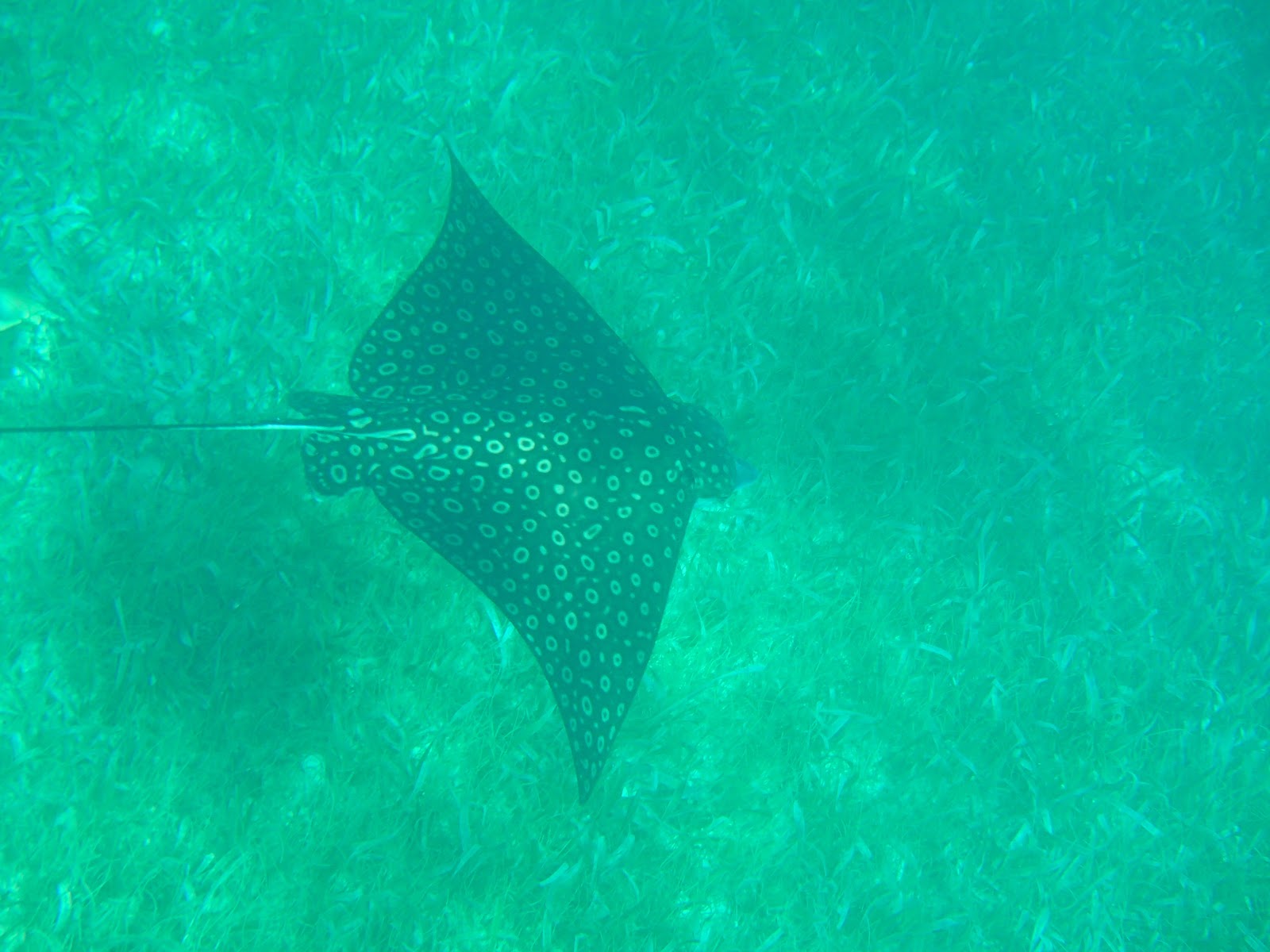
     We all saw spotted rays and a black ray flapping along slowly near the bottom. We swam watchfully six feet above a four foot long barracuda that was hovering completely motionless a few inches above the sandy bottom watching us. Jane saw a large shark go finning off toward deeper water as we approached.

   The wind had died by five o'clock, and we sat on the aft deck sipping cold beer and watching the sun edge down toward a clear horizon. A distant haze turned the sinking sun deep red, and the clouds higher above the western horizon were arrayed from peach to apricot to tangerine to orange to scarlet to red to dark, dark red. Above all that a two day old thin crescent moon shone against a darkening azure sky.

Sunday, November 11, 2012

Adventures In Belize - Day Six

Tuesday, October 16, 2012
      A few sprinkles during the night woke me long enough to close the overhead hatch, but we slept soundly. This morning the wind has picked up to a brisk 16 knots, and the dark blue open water is highlighted with lots of small whitecaps. Today the plan is to sail south to Ranguana Cay.
      John loves the autopilot. It is an amazing piece of electronic wizardry. Coupled with the GPS chart plotter, you can move a cursor on the chart screen to a place on the map, push a button and the automatic steering will keep you exactly on course to that destination. Other buttons at the bottom have easy to understand functions. Push the button on the left side that is labeled one degree, and the rudders will turn a bit, the bow of the boat will come one degree to the left or port side, and then straighten out on its new course. If you push the button labeled ten degrees, the new heading will be ten degrees to port. The same is true for the left. A push on another button lets you take over manual control of the wheel. We stayed on autopilot for most of the eleven miles from South Queens Cay to Ranguana.
      We kept a lookout posted in the bow most of the time to watch for changes in the color of the water ahead from the deep cobalt blue of deep water to the lighter blue that indicates that the bottom is closer to the surface. Correlating the shade of blue to the reading on the depth meter is an easy learning process. Before long I could look ahead, see the color of blue, and realize that I could proceed at our cruising speed of 5 knots, and didn't have to go slowly to avoid running aground. Other areas of lighter blue were indications that we might have to push the autopilot ten-degree button to the left twice, to make a twenty degree deviation from our course to thread our way through a deeper channel between two shallow banks of coral.
      John gave me the helm about halfway to our destination, and I enjoyed playing with the autopilot, although I would have had the wheel on manual had I been making the decisions. Eventually I did take it off auto to pilot the boat manually for the last two miles, swinging wide to the south of the cay to a way-point marked on the navigation map, and then approaching the anchorage slowly to motor close by one of the boats already anchored there. I made a tight 180 degree turn to bring the bow into the wind halfway between the two boats at anchor. Sheila dropped the anchor in ten feet of water, and I put the engines in reverse to back up slowly to a point where all motion stopped, and we were certain that the anchor was holding.
      We went ashore in the dinghy, paid our $10 a head fee for unlimited use of the island and anchorage, and also put in an order for dinner at the small shack that served as kitchen for the restaurant, a coconut frond thatched open sided palapa with picnic tables that served as a dining room. For a few minutes we watched a film crew setting up a shoot about the island for showing on The Wealth Channel.
   Back on the boat, we all donned our diving gear, and slipped over the side into very clear, warm water. the sea floor, only eight feet below was covered with sea grass. We floated lazily along, looking at small fish, conchs, and then a beautiful thirty inch wide spotted ray that flapped its way across the grassy bottom.
     We soon came to a submerged sand bank where very little was growing, although we did see a big gray ray with its wings undulating as it made its way across the empty expanse of rippled sand. At the far edge of the sand bank we began to see bunches of low coral heads, sea fans, and brain coral, about which hundreds of small colorful fish darted in and out of hiding.
Back at the boat again we rinsed off the salt water, dried, changed clothes to shorts and shirts, then motored back to the dock in the dinghy again at six o'clock to return to shore for dinner. The structure may have been crude, but the dinner was elegant...lobster curry, coconut rice, Belikan beer, and then a wonderful coconut pie for dessert.
      At was seven o'clock by the time we finished, and down at the short pier the night was dark as black velvet. John's forehead flashlight came in handy as we scrambled into the dinghy for the trip back to the boat. It's nine p.m. now, and I'm the last one up.
     The wind has died to almost nothing. The surface of the anchorage around us is so smooth it almost seems like the boat is suspended between ocean bottom and the heavens. Small waves chuckle against the bottom of the dinghy and the "Lovely Cruise" pitches gently, bow to stern. Time to sleep!