Tuesday, October 16, 2012
A few sprinkles during the night woke
me long enough to close the overhead hatch, but we slept soundly.
This morning the wind has picked up to a brisk 16 knots, and the dark
blue open water is highlighted with lots of small whitecaps. Today
the plan is to sail south to Ranguana Cay.

John loves the autopilot. It is an
amazing piece of electronic wizardry. Coupled with the GPS chart
plotter, you can move a cursor on the chart screen to a place on the
map, push a button and the automatic steering will keep you exactly
on course to that destination. Other buttons at the bottom have easy
to understand functions. Push the button on the left side that is
labeled one degree, and the rudders will turn a bit, the bow of the
boat will come one degree to the left or port side, and then
straighten out on its new course. If you push the button labeled ten
degrees, the new heading will be ten degrees to port. The same is
true for the left. A push on another button lets you take over manual
control of the wheel. We stayed on autopilot for most of the eleven
miles from South Queens Cay to Ranguana.

We kept a lookout posted in the bow
most of the time to watch for changes in the color of the water ahead
from the deep cobalt blue of deep water to the lighter blue that
indicates that the bottom is closer to the surface. Correlating the
shade of blue to the reading on the depth meter is an easy learning
process. Before long I could look ahead, see the color of blue, and
realize that I could proceed at our cruising speed of 5 knots, and
didn't have to go slowly to avoid running aground. Other areas of
lighter blue were indications that we might have to push the
autopilot ten-degree button to the left twice, to make a twenty
degree deviation from our course to thread our way through a deeper
channel between two shallow banks of coral.

John gave me the helm about halfway to
our destination, and I enjoyed playing with the autopilot, although I
would have had the wheel on manual had I been making the decisions. Eventually I
did take it off auto to pilot the boat manually for the last two
miles, swinging wide to the south of the cay to a way-point marked on
the navigation map, and then approaching the anchorage slowly to motor close by one of the boats already anchored there. I made a tight 180 degree turn to bring the bow into the wind
halfway between the two boats at anchor. Sheila dropped the anchor in
ten feet of water, and I put the engines in reverse to back up slowly
to a point where all motion stopped, and we were certain that the
anchor was holding.

We went ashore in the dinghy, paid our
$10 a head fee for unlimited use of the island and anchorage, and
also put in an order for dinner at the small shack that served as
kitchen for the restaurant, a coconut frond thatched open sided
palapa with picnic tables that served as a dining room. For a few minutes we watched a film crew setting up a shoot about the island for showing on The Wealth Channel.
Back on the boat, we all donned our
diving gear, and slipped over the side into very clear, warm water.
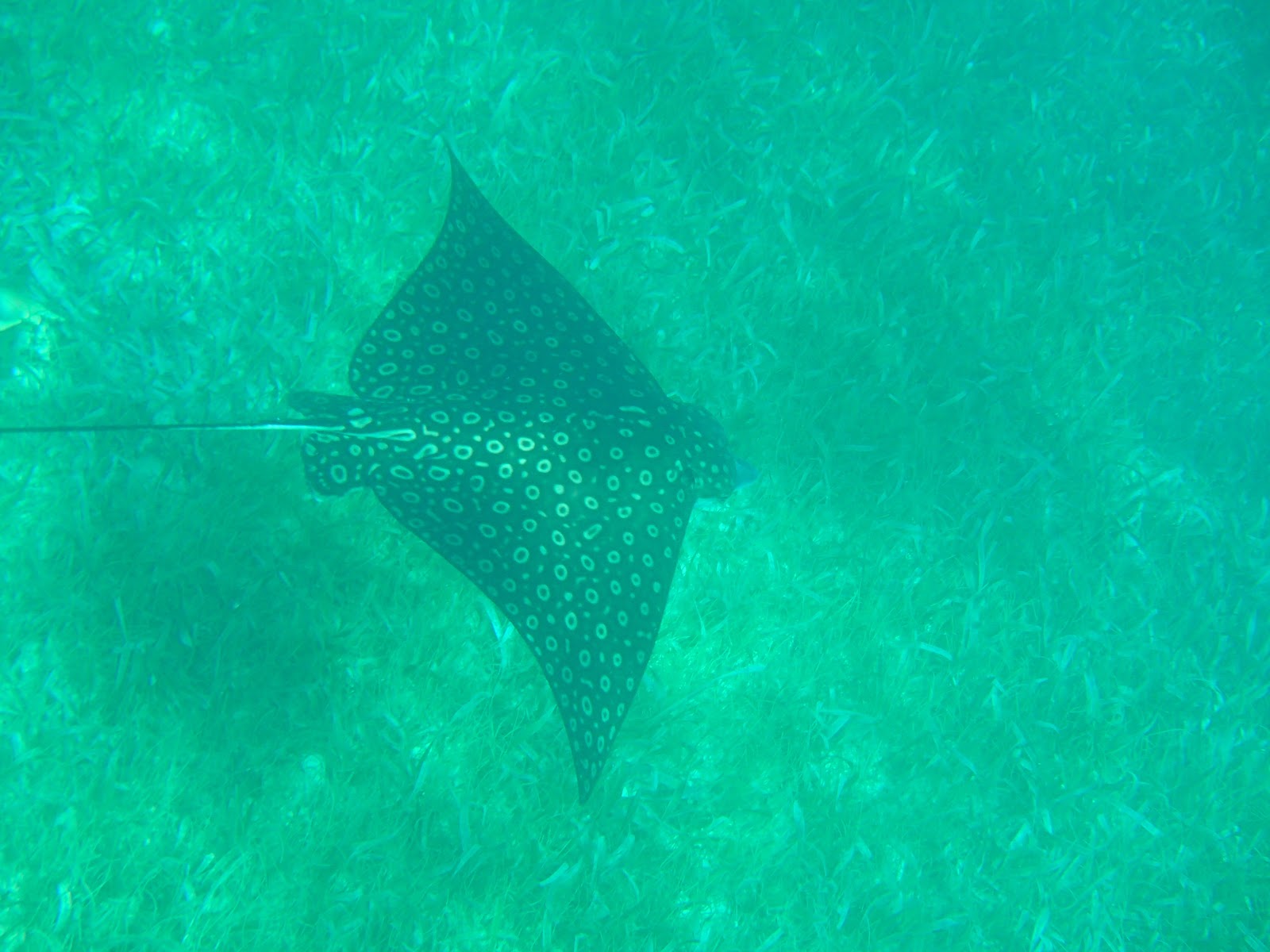
the sea floor, only eight feet below was covered with sea grass. We
floated lazily along, looking at small fish, conchs, and then a
beautiful thirty inch wide spotted ray that flapped its way across
the grassy bottom.
We soon came to a submerged sand bank
where very little was growing, although we did see a big gray ray
with its wings undulating as it made its way across the empty expanse
of rippled sand. At the far edge of the sand bank we began to see
bunches of low coral heads, sea fans, and brain coral, about which
hundreds of small colorful fish darted in and out of hiding.
Back at the boat again we rinsed off
the salt water, dried, changed clothes to shorts and shirts, then
motored back to the dock in the dinghy again at six o'clock to return to shore for
dinner. The structure may have been crude, but the dinner was
elegant...lobster curry, coconut rice, Belikan beer, and then a
wonderful coconut pie for dessert.
the dinner was
elegant...lobster curry, coconut rice, Belikan beer, and then a
wonderful coconut pie for dessert.
At was seven o'clock by the time we
finished, and down at the short pier the night was dark as black
velvet. John's forehead flashlight came in handy as we scrambled into
the dinghy for the trip back to the boat. It's nine p.m. now, and I'm
the last one up.
The wind has died to almost nothing.
The surface of the anchorage around us is so smooth it almost seems
like the boat is suspended between ocean bottom and the heavens.
Small waves chuckle against the bottom of the dinghy and the "Lovely
Cruise" pitches gently, bow to stern. Time to sleep!


 We all saw spotted rays and a
black ray flapping along slowly near the bottom. We swam watchfully six feet above a four foot long barracuda that was hovering completely motionless a few
inches above the sandy bottom watching us. Jane saw a large shark go finning
off toward deeper water as we approached.
We all saw spotted rays and a
black ray flapping along slowly near the bottom. We swam watchfully six feet above a four foot long barracuda that was hovering completely motionless a few
inches above the sandy bottom watching us. Jane saw a large shark go finning
off toward deeper water as we approached.