Showing posts with label Sailing. Show all posts

Thursday, November 15, 2012

Adventures In Belize - Day Ten

     The rain came and went several times during the night, rattling close overhead loudly enough to wake me. I went out on deck as the warm, damp air was beginning to get light. I could hear the calls of birds in the dense vegetation near the marina, accompanied by a frog chorus. Water dripped from the edges of the Bimini top overhead. It dribbled over the edges of the boat onto the surface of the slip. It splashed in the undergrowth, and water vapor twisted in lazy tendrils from the coral sand and gravel up into the still morning air.

     Off in the distance I could hear the faintest whisper of sound in the back ground. It gradually got louder. Looking in that direction I could see a low hanging dark grey cloud moving slowly in my direction. Beneath the cloud was a veil of dark streamers reaching to the ground, dumping a tropical downpour on the jungle as it swept along. The millions upon millions of large raindrops splattering on leaves, splashing into puddles marked its coming with a whispering roar that got louder and louder as it got closer. 
      Billions of raindrops, rushing toward the ground, pushing the air ahead of them, created a warm humid wind blowing out in all directions, carrying the scent of sweet blossoms and decaying vegetation. So dense that the cascading rain obscured the landscape behind it, the storm swept across the marina with an enveloping roar of falling water that lasted only a few minutes and was gone.
     Soon the sun appeared from behind the tattered clouds, just in time to heat the already steamy air as we packed up and lugged dufflebags to the marina office for checkout and to await the arrival of the van to the tiny Placencia Airport.
     We’ve been here a week or so. Now it’s finally time to go; I can’t believe how quickly time has flown. Packing up the bathing suits…that’s a sign we must be going home. When we get back home, and they ask us what we miss most, we’ll shrug our shoulders and we’ll smile…
 

If you would like to see a twenty-five minute video of 
these ten days of adventure,click on the hotlink below.

Monday, November 12, 2012

Adventures In Belize - Day Seven

Wednesday, October 17, 2012
            I missed sunrise this morning. The night was very still, and virtually no breeze came through the open ports and hatch. The small fan was on, but provided little comfort from the heat and humidity, and it was hard to sleep. It cooled some before dawn, and I slept soundly until the sunlight shining through the port hole and the rippling reflections of sunlight on the water shining on the ceiling woke me.
       After breakfast John, Sheila, and I took the dinghy to the dock, walked thirty yards across to the other side of the cay, and explored the reef there. In the sea grass shallows there were countless thousands of two inch long golden striped fish in endless schools and layers. Swimming farther, the grass gave way to a strip of white coral sand, and as we reached deeper water we began to see larger fish, sea fans, and colorful coral formations.
    We spent a good hour floating among the coral heads and branches. Swimming around a large mass of coral I came upon a four foot shark resting on the bottom, its head halfway inserted under a ledge. I backed up, got Sheila's attention, and we swam back to take another look, the video camera turned on. This time the shark saw us. It started, jerking back a bit, and then leisurely turned and swam off into the slightly hazy water.
  We prepared to leave sometime after ten o'clock. The electric winch clattered, reeling in the anchor chain, and then suddenly stopped. Kneeling on the trampoline and looking over the front, I could see that the chain disappeared underneath a very large coral head. We were stuck. Snagged!
John put the engines in reverse slowly while I continued to peer over the front. I could see that the chain curved off at a different angle on the other side of the coral, so all we had to do was maneuver the stern while backing to straighten the anchor line, and we'd be free. John expertly did that, we finished anchor-cranking, and we were under way at last.
            There are a couple of different ways of planning a course between the cays. One mind set dictates that since we are on a sailboat, part of the fun would be to actually use the sails, even if it means sailing a zigzag course, tacking into the wind and taking five or maybe six hours to travel the eight and a half miles to the next destination. 
    A different, equally valid mind set evaluates the situation somewhat differently: The wind is blowing almost directly toward us from the direction we need to go. If we put up the sails it might take most of the day to reach our destination. 
   On the other hand if we turned on the diesels and left the sails down, it wouldn't take more than a couple of hours to reach our next anchorage, and we'd have more time to go snorkeling. Option number two prevailed.
  By one o'clock we were picking up the mooring buoy at Laughing Bird Cay. Two launches were resting their bows on the beach, and we could see people from the dive expedition both in the water and gathered in a palapa - a large open sided thatch roofed shelter on the cay. We ate some lunch and waited. A short time later they all roared off toward Placencia, and we had the island to ourselves, except for the two park rangers that soon came out to collect the $10 per head park fee.
   In the afternoon we all jumped off the back of the boat with masks, fins, and snorkels. The water was forty feet deep, so we couldn't see the bottom, but by the time we had swum fifty yards toward shore we began to see sand and coral far below. In twenty feet of water there was abundant sea grass where we could see conchs inching along.
     The main population of coral was in water ten to twelve feet deep, intersected by random slightly deeper sandy bottom channels. The water was deep enough so that no one had to worry about accidentally kicking any of the delicate coral, and deep enough that there were abundant varieties of medium size fish. We saw angelfish and butterfly fish, yellow tangs and funny little cleaner wrasse. 

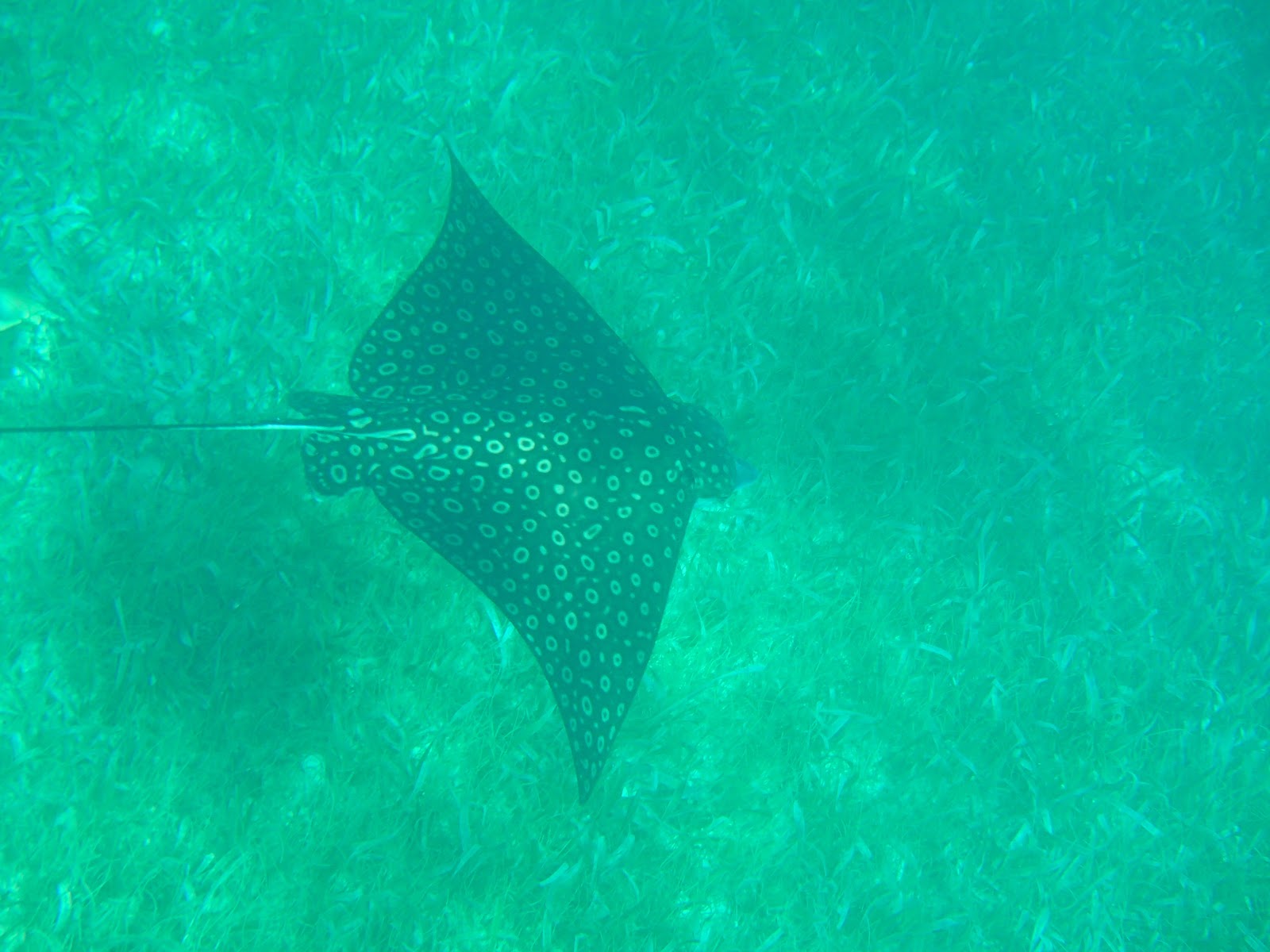
     We all saw spotted rays and a black ray flapping along slowly near the bottom. We swam watchfully six feet above a four foot long barracuda that was hovering completely motionless a few inches above the sandy bottom watching us. Jane saw a large shark go finning off toward deeper water as we approached.

   The wind had died by five o'clock, and we sat on the aft deck sipping cold beer and watching the sun edge down toward a clear horizon. A distant haze turned the sinking sun deep red, and the clouds higher above the western horizon were arrayed from peach to apricot to tangerine to orange to scarlet to red to dark, dark red. Above all that a two day old thin crescent moon shone against a darkening azure sky.

Sunday, November 11, 2012

Adventures In Belize - Day Six

Tuesday, October 16, 2012
      A few sprinkles during the night woke me long enough to close the overhead hatch, but we slept soundly. This morning the wind has picked up to a brisk 16 knots, and the dark blue open water is highlighted with lots of small whitecaps. Today the plan is to sail south to Ranguana Cay.
      John loves the autopilot. It is an amazing piece of electronic wizardry. Coupled with the GPS chart plotter, you can move a cursor on the chart screen to a place on the map, push a button and the automatic steering will keep you exactly on course to that destination. Other buttons at the bottom have easy to understand functions. Push the button on the left side that is labeled one degree, and the rudders will turn a bit, the bow of the boat will come one degree to the left or port side, and then straighten out on its new course. If you push the button labeled ten degrees, the new heading will be ten degrees to port. The same is true for the left. A push on another button lets you take over manual control of the wheel. We stayed on autopilot for most of the eleven miles from South Queens Cay to Ranguana.
      We kept a lookout posted in the bow most of the time to watch for changes in the color of the water ahead from the deep cobalt blue of deep water to the lighter blue that indicates that the bottom is closer to the surface. Correlating the shade of blue to the reading on the depth meter is an easy learning process. Before long I could look ahead, see the color of blue, and realize that I could proceed at our cruising speed of 5 knots, and didn't have to go slowly to avoid running aground. Other areas of lighter blue were indications that we might have to push the autopilot ten-degree button to the left twice, to make a twenty degree deviation from our course to thread our way through a deeper channel between two shallow banks of coral.
      John gave me the helm about halfway to our destination, and I enjoyed playing with the autopilot, although I would have had the wheel on manual had I been making the decisions. Eventually I did take it off auto to pilot the boat manually for the last two miles, swinging wide to the south of the cay to a way-point marked on the navigation map, and then approaching the anchorage slowly to motor close by one of the boats already anchored there. I made a tight 180 degree turn to bring the bow into the wind halfway between the two boats at anchor. Sheila dropped the anchor in ten feet of water, and I put the engines in reverse to back up slowly to a point where all motion stopped, and we were certain that the anchor was holding.
      We went ashore in the dinghy, paid our $10 a head fee for unlimited use of the island and anchorage, and also put in an order for dinner at the small shack that served as kitchen for the restaurant, a coconut frond thatched open sided palapa with picnic tables that served as a dining room. For a few minutes we watched a film crew setting up a shoot about the island for showing on The Wealth Channel.
   Back on the boat, we all donned our diving gear, and slipped over the side into very clear, warm water. the sea floor, only eight feet below was covered with sea grass. We floated lazily along, looking at small fish, conchs, and then a beautiful thirty inch wide spotted ray that flapped its way across the grassy bottom.
     We soon came to a submerged sand bank where very little was growing, although we did see a big gray ray with its wings undulating as it made its way across the empty expanse of rippled sand. At the far edge of the sand bank we began to see bunches of low coral heads, sea fans, and brain coral, about which hundreds of small colorful fish darted in and out of hiding.
Back at the boat again we rinsed off the salt water, dried, changed clothes to shorts and shirts, then motored back to the dock in the dinghy again at six o'clock to return to shore for dinner. The structure may have been crude, but the dinner was elegant...lobster curry, coconut rice, Belikan beer, and then a wonderful coconut pie for dessert.
      At was seven o'clock by the time we finished, and down at the short pier the night was dark as black velvet. John's forehead flashlight came in handy as we scrambled into the dinghy for the trip back to the boat. It's nine p.m. now, and I'm the last one up.
     The wind has died to almost nothing. The surface of the anchorage around us is so smooth it almost seems like the boat is suspended between ocean bottom and the heavens. Small waves chuckle against the bottom of the dinghy and the "Lovely Cruise" pitches gently, bow to stern. Time to sleep!

Saturday, November 10, 2012

Adventures In Belize - Day Five

Monday, October 15th, 2012
   After a hearty breakfast of pancakes, we slipped the mooring lines, swung about, and headed due east under engine power for the short trip to Queen's Cays, a national marine preserve. 
     We changed course slightly to avoid a lighter colored patch of shallower water, and then swung around to approach the southernmost cay heading upwind. We dropped the anchor in 25 feet of water, and after a few moments it took hold, bringing us to a stop twenty or thirty yards from two other sailing catamarans already at anchor.
     Queen's Cays, also known as Gladden Spit or Silk Cays is an extended area of very shallow reef where the surf breaks, at times awash at low tide. There are three very tiny islands stretched out in a line over about a half mile. 
     The southernmost where we and the other boats were anchored has exactly ten short coconut trees crowded onto a cay that couldn't be more than two hundred feet long and a quarter that width. It also has one barbeque pit, and a small shack with men's and women's flush toilets. The cay is also manned during the day by park rangers who are supposed to collect ten dollars for each crew member aboard every boat that visits.
     Jane stayed aboard while John, Sheila, Ruth, Mary Anne, and I dinghied in to the pale green shallow water on the east side of the cay to go snorkeling. I talked to one of the rangers who informed me that the next cay, about five hundred yards to the north is a good place to land a small dinghy, and has excellent snorkeling. The third cay, another five or six hundred yards north of the second is a sanctuary where birds are nesting, and that nobody is allowed ashore there.
     The sandy bottom is only about two or three feet below the surface, very gradually sloping out to deeper water. Millions of silvery inch-long fish formed a dense shimmering layer a few inches about the bottom, parting around me and joining again behind as I floated along.
     The transition from sand to dense populations of sea fans and soft corals was rapid as I swam toward deeper water. Although the water was a bit cloudy, I enjoyed a good hour of watching the many kinds of fish, and taking underwater pictures and video.
     Just after noon, a long open boat with a powerful out board motor on the back, and the words "Nature Reserve Ranger" stenciled on the bow approached our boat as it lay at anchor. The two rangers I had seen earlier on the beach cooking about two dozen chickens on a barbeque grill were aboard, and waved to us. They had come to collect the park fee. They said that the quoted price of ten dollars per night, per person was incorrect, and that it was a one-time charge only. We could stay as long as we liked, but that if we left and then came back again the fee would be collected again. After handing one of them the $60 for the six of us on board, the ranger said, "Well, I only have four tickets, but I can bring you the other two tomorrow if you are still here."
            This was not difficult to figure out. If they had collected sixty dollars, but had to show the sale only four tickets when they reported to their office, they could pocket a nice 33% personal profit on the transaction. John was of the opinion that they likely made only a pittance in salary, and said nothing as he handed them the full amount. They handed him the four tickets, gunned the outboard in a sharp turn, and instead of heading back to the cay, raced off straight toward the deep ocean waters to the east, probably to spend the rest of the day fishing. Although the cruising guide book said that the Queens Cays are manned twenty-four hours a day every day, we have not seen a ranger presence since.
     After lunch on board we watched two sailboats pull up anchor and head out, leaving only one more sailboat lying at anchor with us. A solitary dolphin surfaced a few yards away, took a breath and submerged again, coming up one more time farther away before disappearing.

     The wind picked up a bit in the afternoon, and far off to the west a dark bank of clouds appeared. We decided that an afternoon snorkeling trip should be done sooner, rather than later. This time Ruth and Sheila stayed aboard while the rest of us stumbled aboard the pitching dinghy, and headed for Middle Queens Cay. 
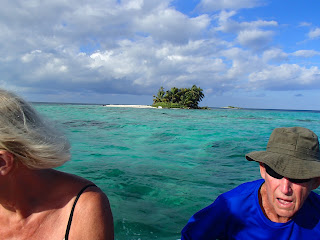
     Approaching the shoaling water from the southeast, the foot and a half to two foot high swells looked a bit to intimidating, and John swung us around to head back to the South Queens Cay where we had gone swimming in the morning.
     The choppy waves were washing across the shallows, but we hopped overboard onto the white sandy bottom in three feet of water, taking the tiny anchor out thirty feet from the front of the dink. Its short eight-inch hooks would not hold in the soft sand, so I dropped it behind a small head of dead coral.
     Although there is only a foot and a half difference here between high tide and low tide, this afternoon there was less clearance between the surface of the water and the tops of the sea fans and soft coral. That, combined with the larger choppy waves sweeping across the reef made it feel as if you would be deposited on something unpleasant with each dip into a wave trough.
     John and Mary Ann struck out for deeper water immediately. Jane floated in three to four foot deep water for awhile before deciding that it was just a bit too uncomfortable. As we headed for the tiny beach I saw that the dink anchor had slipped, and was dragging toward the beach, so I retrieved it and reset the anchor behind a larger coral head.
     We ambled out onto the short sand spit at the southwest end of the tiny cay, watching tiny hermit crabs scrabbling their tracks across the damp beach while they avoided the inch-wide holes where ghost crabs appeared every few seconds to toss sand from their excavated burrows.
   The diner of chicken casserole prepared by Sheila, Mary Ann, and Jane was served on deck, and we spent the evening there chatting. The sky was partially clear by eight o'clock, and we spent some time looking at constellations and the gauzy arc of the Milky Way stretching high across the sky.

Friday, November 9, 2012

Adventures In Belize - Day Four

Sunday, October 14, 2012
     A day much like Saturday, our second day at Hatchett Cay. Waking up as the first light began to brighten the glass hatch and ports of our cabin, I got up and climbed out on deck to watch the sun rise out of the sea at 5:45. It is delightful to be reminded just how pleasant just sitting and observing the evolution of the day can be.
    I noticed one of the Hatchett Cay workers sitting quietly in the dock house, watching the sunrise as I was. Pelicans appeared from wherever pelicans spend their nights, and began to patrol the shallow waters close to the cay, looking for breakfast. The clouds displayed an evolving minimalist symphony of colors, shapes, and movement. They changed from dark shapes rimmed with silver, the highest cumulonimbus tops first turning pink, then peach, and then at least fifty shades of gray and white as the sun climbed higher.
    A finch with bright yellow feathers on each side of its tail flip-tipped its wings and stopped for a moment's rest on the jib sheet before flitting off again. A few dozen little silver fish, each no more than two inches long leaped out of the water and plunged back in again simultaneously, their bright sides flashing in the early morning sunlight. A few minutes later I saw them leap again, this time synchronous with the leap of a three foot long barracuda in hungry pursuit.
     All six of the group scrambled into the dinghy after breakfast for a trip back to the cay. Donning swim fins, masks and snorkels, we all floated again above the graceful sea fans, coral, and multitudes of fish for an hour, and then walked around the tiny island. 
     This time we stopped on the invitation of the manager to climb stairs three stories to a lookout tower on the top of the main building, where we had a beautiful 360 degree view of Hatchett Cay and other cays scattered in the distance.
    After lunch back on board Jane and I motored over to the dock for one more dive session before coming back to spend the night at the same mooring. Late in the evening (which means about eight o'clock when cruising!) the cloudy sky cleared, and Jane, Sheila, Mary Ann and I went out of the forward deck to look for stars and constellations.
      The Big Dipper was too low to see, but Cassiopeia was high in the sky, pointing the general direction to the North Star that hovered, just barely visible only sixteen degrees above the horizon. Cygnus had its wings spread across the Milky Way, which arced high overhead horizon to horizon. As we looked at Jupiter high in the western sky a meteor flashed briefly orange against the blue-black sky.