...a 17 minute video summary of the trip to northern Norway, January 6th - January 18th, 2011
Click here
Monday, January 24, 2011


Thursday, January 13, 2011
Green Ghosts - The Aurora from Tromsø, Norway
It's 11 p.m., and Marit's son Hronn bursts into the living room where we are all sitting around talking and drinking, with "have you decided not to watch the aurora tonight?"
Within seconds everyone is in the entry hall throwing on jackets, slipping stocking feet into boots that are only partly laced and tied off so that they can be put on with firefighter speed. We hurry out into the dry, cold night air, fumbling with gloves, stocking caps, and hoods. The thermometer reads -11 degrees, but that's Celcius. The "real" temperature is 12 degrees Fahrenheit, and you can feel the outer edges of your nostrils getting crinkly.
The sky is a very dark blue-black except over the island of Tromsø where a few low-lying clouds are reflecting back the orange glow of the lights of the town. Extending from behind the sharp ridge of Storstein that rises sharply behind the last row of houses and across the entire span of sky, is a ghostly, faintly glowing greenish band that looks at first like the disappearing remnants of a contrail left in the wake of a long-gone jet plane. Perhaps it is a high, thin, ice crystal cirrus cloud that marks the outer edge of an approaching low pressure system, glowing the light of the nearby first quarter moon, but as we lift our chins high the cloud begins to glow a bit brighter along the middle. It seems to be gathering itself inward, a gradual metamorphosis into a long, sinuous, ropey looking worm of a shape that begins to writhe, leisurely developing bends as if it were trying to slither across the sky.

Farther north, up the sound, another greenish cloud fades into visibility, this one like green grassy filaments spread out and stretched off into the distance in the southwest, more or less parallel to the now slowly wavering line.
We keep looking back and forth across the bowl of the sky, for the horizon to horizon display is too wide to take in all at once. The green ribbon brightens some more over the town of Tromsø while its other end fades almost to invisibility over the mountain ridge. Vertical streaks gradually appear beneath it until it looks like a diaphanous curtain trailing down from the sky, and it begins to move, visibly rippling along its length as if it were being moved by an ethereal breeze.
In truth, this is exactly what is happening. The Sun continuously ejects tons of ripped apart atoms, protons and electrons away from its surface at more than a million miles per hour. At that rate it takes this electrically charged plasma about three and a half days to get to the Earth. Encountering the powerful magnetic field surrounding our planet, most of it is bent right around the Earth and passes harmlessly on into interplanetary space. Some of those electrically charged particles, caught in the Earth's magnetic field, move rapidly toward the north or south magnetic poles. Colliding with the tenuous upper atmosphere, they make the air molecules glow, somewhat similar to the process inside a fluorescent light.
Proximity to the Sun has no particular effect on whether or not the solar wind generates aurora. The Earth reached perihelion, only about 91,400,000 miles from the Sun just a few days ago. The main factor is solar activity. When the Sun belches out large amounts of ionized gas or there is an ejection of plasma from the corona of the Sun toward the Earth, it results in spectacular auroral displays about three days later.

Now the vertical streaks, oscillating gently in the solar wind begin to take on subtle pastel shades of yellow and red, scintillating just a bit along their lower edges. Darker vertical sections travel along the softly glowing wall of aurora, looking vaguely like the shadows of people moving behind a back-lit curtain. It doesn't take a vivid imagination to understand why some Inuit people believed that they could see the spirits of their ancestors moving just behind the northern lights.
A few minutes later the curtains of light fade about the same time that the long green tendril of light across the sky starts to brighten. As we watch, it begins to move sinuously, writhing itself into bends, then whorls, in places fading then brightening again, the motion of the curves somehow snake-like.

So entranced and excited we can barely breathe except for guttural gasps and utterances, we stand in the middle of the street, boots squeaking and crunching in the snow as we turn this way and that, trying to take it all in.
The magic light show begins to fade after about twenty minutes, although we are told that sometimes it continues for hours on end. As we troop back into the house for warm drinks we know that we have seen one of the most amazing wonders of the world.
Saturday, January 8, 2011
Aurora!
January 8
We arrived in Oslo a little before noon yesterday (6 am EST), and had a five hour layover before the 5:30 flight to Tromsø. Our friends from Bradenton , FL arrived about 4 (an hour after sunset!), and we made the last flight 90 minute together.
Our Norwegian host Marit and her sister and their sons and wives all met us at the airport with big WELCOME signs, and we went in two cars to Marit's house in Tromsdalen, and as we pulled up in front of the house her son and grandson were waving torches in greeting, and then touching them to fuses, shooting a volley of brightly colored welcoming fireworks into the air! Marit's house is the last house on a street overlooking the harbor....beautiful in the dark with all the Tromsø city lights reflecting on the water.
We were all sitting around in the living room when someone came in with the word that the Aurora were active! Of course we all threw on coats, slipped back into shoes (since you remove your shoes at the door when you come in) and hurried out onto the porch. The aurora were indeed putting on a show;it looked like delicate blue-green curtains hanging from the sky, sinuously billowing, slow-motion in the wind. Constantly moving, brightening, fading away, reappearing close by or some distance away, they entertained us and totally entranced us for perhaps 5-10 minutes, and then became fainter and stopped altogether. What a literally awesome display!

We sat around talking until almost 1 am. The house is very warm, but the bedrooms are kept at only about 50 degrees, so the fluffy douvet covers on the bed were welcome, if icy when first slipping in. By the middle of the night they retained so much body heat that I actually wished that the bedroom itself was colder! I slept soundly until about 7:30 this morning, and now at 8:30 I'm the first one up, sitting again in the living room enjoying the lights on the waters of the harbor below. So far, I'm the only one awake.
I'm told that much closer to noon the sky does lighten a bit, but of course the sun will not rise above the horizon here until late February.
The sky began to get a lot lighter by 9:30, eventually looking like the sun was about to come up in the southeast by noon. The rest of the group was all up by 11:00 am, and Marit put out a big spread of many diffferent kinds of lunch meat that included reindeer salami, flatbread, scrambled eggs, herring, pickled beets, orange juice, coffee, and we all sat around the table for over an hour, just talking. I can tell already that it going to be difficult not to eat too much while we're here!


The sky began to get a lot lighter by 9:30, eventually looking like the sun was about to come up in the southeast by noon. The rest of the group was all up by 11:00 am, and Marit put out a big spread of many diffferent kinds of lunch meat that included reindeer salami, flatbread, scrambled eggs, herring, pickled beets, orange juice, coffee, and we all sat around the table for over an hour, just talking. I can tell already that it going to be difficult not to eat too much while we're here!
Shortly after noon the sky was as bright as it gets, a dark twilight gray, and five of us piled in Marit's car, a Skoda built in Czech Republic, and headed to Sentrum, the town center. Bundled in heavy coats and gloves we were well insulated. We parked nearby, since only pedestrian traffic is allowed. Crowds of strolling shoppers picked their way cautiously along icy sidewalks under festoons of Christmas lights and red lanterns criss crossing the crowded streets, looking for post-Christmas bargains in the brightly lit shops in the quickly fading light. Near the waterfront we stopped for drinks in a cafe where customers were enjoying the flames of the fireplace as much as the warmth of companionship. By 2:30 in the afternoon night had returned.

By dinner time, Marit's house was full of people. Counting sisters and sons, wives, girlfriends, grandchildren, and guests there were an even dozen at the table for dinner, three huge pans of home cooked pizza.
At 8 in the evening Marit's sister who lives just down the street, called with an aurora alert, and the seven of us remaing in the house hurried to the entry hall, throwing on heavy coats and slipping into boots in a drill that must have resembled the rush of firemen answering the call to a four alarm fire.

Tonight's display was fainter than the previous night, this time a single narrow band stretching across the whole sky from the crest of the steep mountain ridge behind the house across the harbor and disappearing below the opposite horizon ridge line of the island in the west beyond Tromso. We stood outside for 15 or 20 minutes waiting for it to brighten or show some movement like the dancing aurora of the night before, but eventually they simply faded away.
Transatlantic Travel
10:15 pm EST and we've been airborne for 5 hours, which means we're traveling at about 500 mph somewhere over the Atlantic northeast of Newfoundland with another 2,000 miles to go and 4 hours to touch down in Amsterdam. It's 70 degrees below zero outside. This A330 Airbus is a wide body jet with 2-4-2 seating, which means that there are about 250 people aboard. We'll land at 8:00 am local time dragging groggy bodies, still believing that it's only 2:00 am!
Each seat back has its own interactive TV screen, with an extractable armrest controller that allows the selection of perhaps 25 different movies in sevderal languages, an active map that keeps track of aircraft progress or lets you roam the planet. There are 6 different music channels, a number of video games, information in English, French, German, Chinese, and Japanese, and the ability to send email at $2.50 per message.
Even with all the selection, the man across the aisle is watching a different movie on the tiny screen of his Ipod. People are sprawled in an amazing variety of contorted positions, trying to fit tired bodies into small, cramped spaces.
Unlike domestic flights, transoceanic Delta flights offer a very nice dinner service with chicken, pasta, mixed vegetables, crackers, cheese, choice of red or white wine or beer, and a fudge brownie for dessert. An hour out, the lights brighten, and the flight attendants bring around breakfast of an egg mcmuffin and coffee.
It's a few minutes after 8:00 am when we land at Schiphol Airport, the sky is still totally dark, not even a pre-dawn glow. Amsterdam is about fifteen degrees farther north than Richmond, Virginia where the sun rose yesterday at 7:25 a.m. In Amsterdam the sun rose today at 8:45. Although the local clocks are reading 9:30 am now, it's still only 3:30 a.m. in Richmond, and without much sleep, today we'll be tired early! Our KLM flight leaves in an hour. Next stop: Oslo, Norway.
Oslo ...a five hour layover. The airplane flaps extend with a whine, signaling our final approach to the Oslo airport. On the ground the air temperature is 10 degrees, and as we float down toward the runway we can see that the undulating countryside is white. Smooth snow lies on the ground, blurring the boundaries between land and lake. Smooth snow lies on evergreens crowded shoulder to shoulder off into the distance, each branch bearing a load like white cotton, giving the appearance of a stylized Christmas card. Smooth snow spreads like cake icing over every roof, turning houses into models of Kincaid paintings, tendrils of smoke climbing into the still air. A ten foot deep layer of dense white frosty fog has settled in low lying hollows, sliding and curling around and over fields, trees, and houses, giving the whole scene an other-worldly feel.
It's just past noon when the sun reaches its highest point in the sky for the day and starts its descent toward another long night. At midday the angle of the sun makes it feel more like a late Richmond afternoon. Sunset here today is at 3:30 p.m. and it won't rise again tomorrow morning until 9:15.
Thursday, December 23, 2010
Warm River Cave - an old story
...from long ago and not so far away....


A few miles north of Covington, Virginia just off State Route 220 lies the entrance to an alien world visited in winter by Richmond area educators on a teacher adventure sponsored by the Mathematics and Science Center. Our field trip leader, a science teacher in Hanover County, had gotten permission for access to the cave, which is on private property.

We drove off the main highway only a few hundred yards. There we parked the van that had brought us from Tawny's Cave near Blacksburg where we had explored the day before. On the slope of a hill near the road there was a misty cloud floating up from the ground into the cold December air. The temperature was only in the 20's so we bundled up carefully before getting out. We walked toward the rising column of steam and discovered a pit with sheer sides about eighty feet deep.
After receiving instruction from our leader we free-climbed down the rock walls of the pit clinging to small jagged toe holds and jamming fingers into small cracks in the frozen rock being cautious not to step on any icy spots. At the bottom of the hole there was a wall of steamy air, and as we stepped through it into the entrance room of Warm River Cave all of a sudden we were out of the cold. It was warm!
The day before we had left Richmond early in the morning and had spent most of the day exploring Tawny's Cave. Just off the road to Mountain Lake, Tawny's is a cave that very likely matches your mental image of the way a cave SHOULD look, complete with sinuous interconnected passages, stalactites, drip stone formations and even a few bats hanging from the ceiling.
Warm River Cave is very different. It is a limestone cave but it doesn't' have many stalactites or stalagmites. Instead it consists mainly of "breakdown". Water flowing underground has carved away so much rock that the whole inside of the mountain appears to have caved in on itself. The huge jagged boulders dropped down in tumbled confusion, leaving lots of space to crawl between the rocks. It was like climbing through the spaces in a jumbled pile of building blocks.
We left a change of clothing in the entrance room and began to climb down and down and down, ever deeper, sometimes squeezing through openings so small that we had to hump through them stretched out flat like caterpillars, scraping rock a little on all sides.
Before long we came to an eerie part of the inside of the mountain where the entire rock structure of the mountain had dropped a short distance without breaking. Imagine a crack three and a half feet wide, tipped at an angle of forty-five degrees, stretching up past your head for fifty to a hundred feet, and just below your heels jammed onto a three-inch ledge slanting down, down, down, out of sight beyond the reach of your helmet-mounted light. It was like a mountain within the mountain. It stretched off into the distance below me and as far to the left as I could see in the dim light of our headlamps. It was spooky, but exciting!
We wedged our way sideways across this subterranean rockfall for a least another ten minutes before reaching another area of tumbled breakdown where we could continue our descent. Now whenever we stopped to catch our breaths, we could hear the murmur of water rushing across rocks somewhere still deeper ahead of us.
A few more minutes of scrambling and sliding down over rocks brought us to an underground stream five feet wide and a foot or two deep, its rushing waters plunging off downhill into the blackness. There was enough space to climb along the tumbled rocks at the edge of the water for another hundred yards before we came to a spot where it was evident that two underground streams joined each other. A cold stream welled up from under some rocks to the left, and was joined by a smaller stream rushing out of a low passage to the right. It was obvious that if we wanted to go any farther, not only would we have to crawl, we would have to crawl IN the water! The water felt just slightly cool to us as we got down gingerly on hands and knees, but within seconds it felt comfortable. It must have been at least 70 degrees!
For the next two hours we were rarely off our hands and knees, and that was usually to drop to our bellies to pull ourselves along in the water with forearms, elbows, and toes as if we had been attempting to bypass an enemy outpost in some jungle war-movie!
In a few places the roof of the passageway dropped so low that we had to take off our helmets and float through narrow openings on our backs, noses a half-inch above the surface of the water and an inch from the roof, rocks pressing in to within inches of our cheekbones. In one place, not even that technique would work. We had to submerge to get under the rock that just barely cleared the surface of the water in order to be able to continue on the other side. It was challenging!
Occasionally we would come to small rooms or the passageway would open out wider, providing enough headroom to stand up and walk, splashing along in the streambed for a hundred feet or so. More than once in these rooms we could see other passageways leading off in different directions higher up. The cave evidently has many different levels.

Finally we came to a larger room with flow stone cascading in petrified falls down the walls. There were beautiful shallow rimstone pools here, with chuckling four-inch waterfalls. Off to the right side of the room was a deep pool of water. Shining our lights into the pool we could see it slanting back steeply under the rock wall forty or more feet deep, crystal clear and beautiful sky blue, to a point where we could see no farther. This was one of the warm spring sources of the underground stream that we had been following.
Far back into the mountain, we came to a larger chamber that had steep, slippery clay banks slanting up out of the water thirty feet or more. Like children, or uninhibited otters, we spent the next half hour scrambling up the incline to take turns slithering back down our improvised mudslide into the warm, muddy water, while the passageways of the cave echoed back our whoops, shouts, and laughter.
Traveling back through the water-filled passageway was easy: the hard part was the long climb back up to the surface over cold rocks, in air that felt even cooler on our wet clothes. As we climbed out of the pit into a fierce snowstorm and raced for the warmth of the vans, we knew we'd had a real adventure!
Tuesday, November 30, 2010
Modern Cities You've Never Thought Of
I've stopped to spend a leisurely hour in the city of Hartsfield. Sitting beside one of the major thoroughfares, I'm watching the heavy traffic flowing in both directions, and speculating on the origins and destinations of all the other travelers passing through.
You won't find the city of Hartsfield designated as such on any map of Georgia, although its average population must make it one of the larger cities in the state. The climate is remarkably even, varying little from an ideal 70 degrees , summer or winter, year around.
Hartsfield is a futuristic city. Conventional cars must be left in parking lots on the outskirts of the city. A robotic rapid transit subway system whisks commuters between the business areas of the city, and a woman's soft computerized voice announces each station stop. The few vehicles you see here are electric powered, and are reserved only for those who are unable to walk easily. Virtually all of the traffic within the city limits is pedestrian.
The entire population of this city has arrived recently, actually within the last few hours, and although I'm told that the number of people here at times exceeds fifty thousand, no one stays long. There are no residences here, and workers leave at the end of their shifts to travel to bedroom communities located in Atlanta or other nearby towns within easy driving distance. Hartsfield, with its totally transient population is indeed a city of the future, complete with its own roads, shopping malls, fire department, police force, and city administration.
This is a new kind of city, having come into existence only within the past couple of decades, taking its place along with the other great unmapped cities of its kind like O'Hare in Illinois, Dulles in Virginia, Heathrow in England, and Le Bourget in France.
Like the traffic in more conventional cities, the volume of traffic in the city of Hartsfield ebbs and flows fitfully, punctuated by the low rumbling roar of jet engines in the background. Fascinating as it is, everyone seems anxious to leave, stopping in clusters to scan with furrowed brows the rows of digital data on banks of computer screens that display a continuously changing list of arrivals and departures.
Somewhere far off to the south, a couple of weeks walk, many hours of driving, or an hour and twenty minutes by plane, other intent eyes are scanning digital data on other banks of computer screens, all of them focused on the departure of a single flying machine now scheduled to leave on Dec. 17 at 8:51 p.m. EST. That is the tentative targeted time when space shuttle Discovery will leap for the last time from Pad 39A at the Kennedy Space Center in Florida. I'll be watching.
A faceless voice is announcing my own departure from this strange city. It's time to grab my possessions and to join the others crowding to leave Hartsfield International Airport. I know that I'll be back. Even though I wouldn't want to live here, it's a great place to visit!
Friday, November 12, 2010
Latitude Lassitude
What can you say about an interstate highway...any interstate highway? Basically they all look the same, with minor variations. They are the cement incarnation of a Phillip Glass symphony...seemingly endless repetitions of the same theme, gradually, very gradually evolving from one thing into something else. The music changes with the surface underneath the tires; whispering over smooth asphalt, humming over longitudinal highway grooving, whining over transverse grooves, the tarmac tympani changing the beat from thump-a-thump, thump-a-thump to kathunkety-thunk, kathunkty-thunk as the spacing between the expansion joints changes.

The vegetation gradually changes size, type, texture, tint. The trees seem to observe the state borders. Cruising down Interstate 95, soon after we cross into North Carolina we begin to spot the wispy gray beards of Spanish Moss hanging from tree branches. As we near the the lower side of South Carolina, very close to the Georgia state line we spot the first palmetto trees, and leave the predominant oaks, maples, and sycamores behind.
The colors of the highway change too as we travel, sometimes dark and smooth, then dark with millions of sparkling mica facets that catch and reflect the sunlight, paving the highway with countless diamonds. In parts of Virginia the highways have a distinct greenish tinge from the Catoctin Greenstone gravel that goes into the cement mix, but in Florida the cement pavement of I-95 South is glaring white like the low white sand dunes we see as we turn east off the Interstate toward Cocoa Beach.
Perhaps the most magical change is the air itself. Tropical air is sensuous. Why is that? Surely not just the varying amount of moisture in the atmosphere, since that fluctuates seasonally in Richmond from dry to saturated, and it never feels like Florida. I think that it must be the unique combination of ocean salt in the air and the vegetation. Indian River grass washed up and decaying on sandy western shores, sawgrass, palmetto, swamp-smells blended with hints of flowers and the warm moist air all blend in a heady recipe that seeps into your lungs to work its spell. A few deep breaths and you want to get rid of shoes and wiggle toes in white sand, rub pungent coconut oil on your skin, lie in the sun or sprawl on warm sand. The resulting change of attitude might be blamed on latitude. It isn't exactly ennui, but gone are any plans that involve hurrying. Fading fast is any kind of planning at all. Normally get up at 6:30 or 7:00? Try 8:00 or even 9:00 without a twinge of regret! Thought you might go fishing or paddle a kayak on the Indian River in the morning? Why rush? The river will still be there this afternoon, or tomorrow, for that matter. A few insidious thoughts creep in that you should be doing something, but hey!....sitting and watching a snowy egret stealthily hunting breakfast, or taking note of the changing shapes, colors, and textures of the clouds overhead or watching distant sailboats scurrying south along the Intra-Coastal Waterway...well, those are doing something!
Friday, October 29, 2010
On the Road Again
Failure to launch! We had not yet left Richmond today when a friend in Florida called, saying that he had just heard that the Shuttle launch had been pushed back from Monday afternoon for at least 24 hours while maintenance crews search for and repair nitrogen and helium leaks in the port-side Orbital Maneuvering System on Shuttle Discovery. We'll continue on schedule our trip to Florida anyway, pleased that we have reservations for multiple nights at the Long Point Campground south of the Kennedy Space Center.
The day is perfect for cruising the interstate: bright sunshine, cool but not cold, a cloudless sky - except for one tiny spot of white that looks like a hovering UFO. As we roll through southern Virginia approaching the North Carolina border there are lots of cotton fields, millions of dark, dried stalks holding their puffy white harvest up to the Autumn sunshine.
The traffic is steady but not too heavy, and we see lots of vehicles with Canadian plates on motor homes and trailers...Québécois fleeing from temperatures that are already dipping at night into the 20's, heading for extended stays in Florida.
The mid-day sunlight illuminates the leaves of trees turning yellow, turning them to glowing gold, shimmering as they flutter in the afternoon breezes. The gusty slipstream that chases tractor trailers makes the long green blades of grass along the roadside ripple in waves, shiny and scintillating, reflecting the sun.
North Carolina scrolls past the windows, showing off its magnificent treatment of interstate landscaping. Spectacular six-foot-wide alternating strips of red and white flowers near on and off ramps mimic the red and white stripes of the American Flag.
Signs and billboards along the road clamor for the attention of drivers, each attempting to outdo its competitors with extravagant claims. "35,000 Towels in stock at J&R - Exit 97", "World's Largest Gun Show Next Exit!!!", "See and Do Orlando"!
Anything that may break through to the jaded senses of drivers, enticing a short stop, is a plus. Although Kenly, NC is over a hundred miles from the ocean, a truck stop within sight of I-95 has erected a towering replica of the real lighthouse at Cape Lookout. Beginning in the middle of the state, over a hundred miles from North Carolina's southern border you begin to see really "kitchy" signs exhorting you to stop at "South of the Border", a complex of arcades, gift shops, rides, and greasy-spoon fast-food enterprises just over the border in South Carolina. A huge slab of a sign bigger than the boxy building beside it shouts, "LARGEST SELECTION OF FIREWORKS ON THE EAST COAST!"
 The sun is dipping below an orange horizon as we pull into Santee, South Carolina for some dinner. We'll spend the night here, and continue our slide south in the morning.
The day is perfect for cruising the interstate: bright sunshine, cool but not cold, a cloudless sky - except for one tiny spot of white that looks like a hovering UFO. As we roll through southern Virginia approaching the North Carolina border there are lots of cotton fields, millions of dark, dried stalks holding their puffy white harvest up to the Autumn sunshine.
The traffic is steady but not too heavy, and we see lots of vehicles with Canadian plates on motor homes and trailers...Québécois fleeing from temperatures that are already dipping at night into the 20's, heading for extended stays in Florida.
The mid-day sunlight illuminates the leaves of trees turning yellow, turning them to glowing gold, shimmering as they flutter in the afternoon breezes. The gusty slipstream that chases tractor trailers makes the long green blades of grass along the roadside ripple in waves, shiny and scintillating, reflecting the sun.
North Carolina scrolls past the windows, showing off its magnificent treatment of interstate landscaping. Spectacular six-foot-wide alternating strips of red and white flowers near on and off ramps mimic the red and white stripes of the American Flag.
Signs and billboards along the road clamor for the attention of drivers, each attempting to outdo its competitors with extravagant claims. "35,000 Towels in stock at J&R - Exit 97", "World's Largest Gun Show Next Exit!!!", "See and Do Orlando"!
Anything that may break through to the jaded senses of drivers, enticing a short stop, is a plus. Although Kenly, NC is over a hundred miles from the ocean, a truck stop within sight of I-95 has erected a towering replica of the real lighthouse at Cape Lookout. Beginning in the middle of the state, over a hundred miles from North Carolina's southern border you begin to see really "kitchy" signs exhorting you to stop at "South of the Border", a complex of arcades, gift shops, rides, and greasy-spoon fast-food enterprises just over the border in South Carolina. A huge slab of a sign bigger than the boxy building beside it shouts, "LARGEST SELECTION OF FIREWORKS ON THE EAST COAST!"

Thursday, October 28, 2010
The Final Countdown

Now on Thursday evening, October 28th its final liftoff is less than a hundred hours away. The astronaut crew members flew in to the Kennedy Space Center from Houston this afternoon.

Monday, September 20, 2010
Rappahannock River Adventure
September 18th, 2010
We got a late start on Saturday morning, driving the Chinook RV East on I-64, Rt 33 through West Point to Rt 17, and then on smaller roads eastward to Topping, Virginia.
 Turning down a dirt road we came to Camp Kekoka on Indian Creek. An all-day music festival was already in progress, but we had come to listen to our neighbor Robbin Thompson play at 3:30.
We strolled down to the dock to look out across the water, searching for Robbin's sailboat "Song Bird". It was nowhere insight, although he had posted on his website that he was looking forward to sailing from his home slip in Jackson Creek near Deltaville to the concert. We wondered if he was still beating north to windward against the strong winds blowing down the Chesapeake Bay.
 We moved our folding chairs closer to the performance stage as Robbin's assigned time got close, and enjoyed a full hour of his songs, including "Out on the Chesapeake", and his best-known and most popular composition "Sweet Virginia Breeze" After the concert we drove back across the high bridge spanning the Rappahannock River to Grey's Point Campground for a sunset paddle in the kayaks, and to spend the night.
September 19
After a leisurely breakfast we packed up and headed north on Rt 3, eventually turning back toward the river and Belle Isle State Park, which preserves over 700 acres of riverfront, marshes, and forest. We put our kayaks in at a sandy bottomed spot on one of the tidal creeks, and explored the marshes for several hours before heading back to Richmond.
 Click here for video
A great way to celebrate the last weekend of summer!
We got a late start on Saturday morning, driving the Chinook RV East on I-64, Rt 33 through West Point to Rt 17, and then on smaller roads eastward to Topping, Virginia.
 Turning down a dirt road we came to Camp Kekoka on Indian Creek. An all-day music festival was already in progress, but we had come to listen to our neighbor Robbin Thompson play at 3:30.
We strolled down to the dock to look out across the water, searching for Robbin's sailboat "Song Bird". It was nowhere insight, although he had posted on his website that he was looking forward to sailing from his home slip in Jackson Creek near Deltaville to the concert. We wondered if he was still beating north to windward against the strong winds blowing down the Chesapeake Bay.
We bought hot dogs at a vending stand, and as we stood listening to the music and munching on our summertime luncheon, Robbin came up to say hello. He had slept on his boat and had planned to sail up to Indian Creek, but the 30 knot north winds and 4 foot seas had convinced him that driving his car was a more comfortable option!
 We moved our folding chairs closer to the performance stage as Robbin's assigned time got close, and enjoyed a full hour of his songs, including "Out on the Chesapeake", and his best-known and most popular composition "Sweet Virginia Breeze"
September 19
After a leisurely breakfast we packed up and headed north on Rt 3, eventually turning back toward the river and Belle Isle State Park, which preserves over 700 acres of riverfront, marshes, and forest. We put our kayaks in at a sandy bottomed spot on one of the tidal creeks, and explored the marshes for several hours before heading back to Richmond.
Click here for videoA great way to celebrate the last weekend of summer!
Friday, September 3, 2010
Kayaking The Chicahominy
 The Chicahominy River flows roughly northwest to southeast, all of it across the almost-flat coastal plain of Virginia known as "Tidewater". Here, when the tide is ebbing rivers flow toward the Chesapeake Bay and the Atlantic Ocean, but as the tide turns and begins to rise, the river currents slow, stop, reverse their direction, and for six hours flow upstream. The river meanders its sinuous course across the coastal plain, mostly shallow and spread out, filling the swampy areas along both sides and providing a rich ecosystem that is difficult for humans to develop. Mattaponi and Pamunkey tribes settled along its banks long ago, living in harmony with their surroundings and being supported by the river and marshes. Each tribe still has land along the river.
At its broad mouth, the Chicahominy joins the even wider James River just above Jamestown. Here, on land next to the new Route 5 Bridge, James City County maintains a wonderful park that includes acres of woods, picnic areas, a large grassy field, a boat launch ramp, and lots of camping sites.
As long as you pay attention to whether the tide is flowing in or out, the flat water here is a wonderful, easily accessible place to enjoy a paddle on the river.
Tuesday, August 17, 2010
Hot Air Ballon Adventure

Determining that the light breeze and the weather report were both good, he instructed us to walk with him just a short distance to an open area, where he and his assistant unloaded the huge bundle that contained the balloon, and the large basket that all ten passengers would ride in. The balloon was stretched out and attached to the tipped-over basket, and a gasoline-driven high-speed fan was used to blow cold air into the balloon opening to begin the inflation. Once there was adequate space the double propane burners at the top end of the basket frame were turned on, quickly filling the balloon.
We all scrambled in, and seconds later we drifted slowly into the air accompanied by the loud roar of the propane burners. A few short blasts, and all of a sudden it was totally quiet as we floated across a small lake near the Inn, over a road and an affluent neighborhood out toward wooded countryside.
The sun was low on the eastern horizon as we sailed along. There was very little sensation of movement. Since the air all around the balloon was moving at the same slow speed as the balloon itself, it felt more as if the balloon was stationary and the ground was somehow scrolling past beneath us.
Do you think you'd like to do this too? Investigate here:
www.comeflyinmyballoon.com
Wednesday, July 7, 2010
A Visit to London
....Arkansas, that is! It's a two day trip from Richmond, Virginia. The first day of driving follows I-64W to I-81S down through the SW tip of Virginia at Bristol, crossing over into Tennessee, and then West on I-40 about halfway through Tennessee before stopping for the night. The morning of the second day is for completing the long stretch that covers the rest of Tennessee, then across the Mississippi River into Arkansas, through Little Rock in the middle of the state, and on another 80 some odd miles through Russellville on the edge of Lake Dardanelle to the crossroads of London, population just under 1,000 people.
My daughter Lynne and her husband Blake Slater live there, along with grand-daughter Devin, our main reason for going. Lynne is signed up for a week-long, three-unit course that is being given an hour and forty minutes one way drive from home, and we're staying with Devin during the day while Mommy and Daddy are away.
It's summertime, and it's HOT! One way to cool off is for the kids to play in the sprinklers!
Tuesday, December 22, 2009
2009 in Review
This is the annual Christmas letter sent out to friends. This year it's been so delayed that if the post office is efficient, the letters we mail will arrive sometime between Christmas and New Years!
Merry Christmas 2009
It’s been a busy grand-parenting year! Our first 2009 trip was a drive to Arkansas in our gas-sipping Honda Insight for a New Years visit with George’s daughter Lynne, her husband Blake, and our granddaughter Devin. We went back again the first two weeks in May to be resident grandparents to Devin while her parents Lynne and Blake celebrated their 20th anniversary with an adventure trip to Costa Rica.
Devin is two years old and so is Kaylee, daughter of my son, Mark. Mark and his family live only an hour away, so several times every month throughout the year we are able to visit and have dinner with Mark, his wife Emmie, and grandchildren Dylan and Kaylee.
In February, after Super Bowl weekend, we decided to escape the icy-cold Virginia weather, and packed up the Chinook RV for a dash to the tropical surroundings of Florida. The trouble with that plan, however, was that the cold front followed us all the way to the Florida Keys, and we discovered that while we were dealing with Florida temperatures in the 30’s, in Virginia it had climbed back up to the 50’s! Still, we enjoyed some wonderful bird watching in the Florida Everglades.
In March I dug a monster hole almost six feet deep in the front yard to uncover a break in the water line. We spent a chilly week with friends and family at Emerald Isle beach in North Carolina, enjoying walks on the beach and playing lots of music together in the evenings with harp, recorders, tin whistle, autoharp, banjo ukulele, and hammered dulcimer.
Jane’s artificial knees, put in five years ago, are doing well. After training, she felt strong enough to join me in the annual Monument Avenue 10k, along with almost 33,000 other walkers and runners. Jane walked, I ran; we both finished. After it was over, in a moment of seventy-one year old madness, I signed up for and began training four times a week with the Richmond Marathon Training Team. Extra aerobic exercise was provided in May by digging a monster five foot deep hole to locate a second water main break in the front yard!
With the warm weather and the approach of summer, we enjoyed paddling our recreational kayaks on outings to the James and other Virginia rivers. My stepfather Forrest Keck died in June at age 100, and we spent some time in Oakland, California taking care of affairs and visiting with my relatives. We drove to Redding in northern California for a visit with my son Bruce, who is working on a degree in nursing there. The three of us explored the countryside, and climbed the slopes of Mt. Lassen.
We flew from California to Victoria, British Columbia, the springboard city for several weeks of touring and kayaking on Vancouver Island. First, we made our way with eight friends from Richmond to God’s Pocket on Hurst Island for a week of daily sea-kayaking and hiking on the shores of islands we visited, seeing lots of eagles, other sea and shore birds, porpoises, orcas, and humpback whales. The two of us meandered back south down the island, ending with several days at wonderful Victoria, being hosted by a college friend of Jane’s who lives in Victoria.
In late July we hosted our Kansas City great-nephew Alex. For a week we and Linda, Jane’s sister, delighted in providing East Coast adventures before bringing him with us for an early August beach week at Emerald Isle NC with his grandparents. By now my marathon training runs had increased to over 25 miles a week, and at the end of the month I completed my first half-marathon. We found that the demands of the training ate amazing amounts of time as the mileages increased, but did find time to get out sailing a few times in September in our boat “Starlady” on the Mobjack Bay.
October was busy with a visit in Bedford, VA with French visitors to the Bedford D-Day Memorial, another week at our favorite beachfront cottage in Emerald Isle, and the home stretch of long-run training for George. We co-wrote and presented a planetarium program for the Science Museum of Virginia, one of four we did this year. As November approached, we flew off to Costa Rica for a delightful week with George’s cousin Mary, her husband Bill and several other couples. We went sailing, snorkeling, visited national parks, soaked in mineral-laden hot springs, climbed and rode a zip line through the rain forest before heading back into colder weather.
In mid-November the local NBC station interviewed me as the oldest member of the 1,200 people on the Richmond Marathon Training Team. The marathon was on a cool Saturday morning, and my friend Marilyn popped up next to me on the course several different times, jogging with me for many miles, waving a sign on which she had painted "GO GEORGE GO!" and encouraging onlookers to join the chant! Jane managed to observe my progress from four different vantage points along the marathon route, at one place playing loud cheering on a boom-box. As I crossed the finish line at 6 hours, 2 minutes, and 43 seconds, the TV crew was there to catch the old geezer finishing. That same evening we both danced at the wedding reception of our friends Leslie and Scott. To top off November, my daughter Lynne and I went on a trip to Panama for a week with plane tickets and accommodations I had won in a drawing!
On December 8th we celebrated our 25th wedding anniversary. Friends and family joined us at the James Center downtown to enjoy the Christmas lights, a celebratory dinner, and a Christmas concert. We are planning to spend Christmas Day with 98 year old Aunt Mary Frances and Jane's sister Linda. Then we will fly to Kansas City to visit Andy, Jane’s brother, and his family. A quick trip to see Devin (and of course, her parents) in Arkansas will bring our year to a close.
Best wishes for a wonderful 2010 to you and those you love.
Saturday, December 19, 2009
Nor'easter!
It has been years since warm, moist air swept up from the Gulf of Mexico to meet icy air pouring down from Canada to meet over Virginia and dump lots of snow. In Richmond this morning there were 10" on the ground near the James River. The only vehicles moving were trucks and SUV's. I put on cross-country skis and made my way to the top of our hill, about a mile from the house, and enjoyed a nice downhill run back down the middle of Scottview Drive to Riverside. More skiing this afternoon on the trails in James River Park.
Saturday, December 12, 2009
The last few days of Fall
It's beginning to feel more like winter than Fall. More and more nights when the temperature drops below freezing. It's time to be inside with dancing flames in the fireplace and carols playing. It's a time for good food and good wine and good friends.
Saturday, November 28, 2009
Panama - a Trip to Embera Puru -Part II
On our arrival in Embera Puru we were escorted by most of the village up from the river bank and into the meeting house, a large rectangular open sided building with palm thatching.
 The chief and his wife greeted us in Embera, and the shaman translated into Spanish. Anne Gordon de Barrigon our tour guide is married to Otniel, a member of this tribe. She translated the Spanish into English for us as our hosts described life in the village.
This group had lived in the Choco region. About 35 years ago they fled the abuses and bad treatment they were enduring, and came north, through Darien, which includes the southernmost part of Panama and adjacent lands in Colombia, searching for a better place to live. They found it in the rainforest off a branch of the Chagres River, a spot with a high bank above flood level, relatively easy access to more populated areas down stream, plenty of fish, and good hunting in the forest. They were already living there when the government of Panama formed the 500 square mile Chagres National Park in 1985 to protect the watershed that is so essential to the continued operation of the Panama Canal. Water is vital to the function of the canal locks since each boat that crosses the locks needs around 52 million nonrecoverable gallons of fresh water. The Chagres River is dammed downstream from Embera Puru, creating a large reservoir lake that feeds water in Lake Gatun, which in turn functions as a big section of the canal, and provides water for the operation of the locks. The Embera were grandfathered in and allowed to stay on their land, living pretty much as they always have, hunting and fishing, growing a few rainforest crops and harvesting a wide variety of medicinal plants from the surrounding jungle for their own health needs.
 Their homes are built up off the ground about ten feet to keep things dry in a very wet, rainy region and to reduce the risk of snakebite from fer-de-lance, coral snake, and the central american bushmaster, all of whom are very venomous. Access to each house is via a log with steps chopped into it, leaned up against the elevated floor. The springy, resilient floors of the houses are made from the thick flattened bark of a local tree. Under the house is reserved for storage and hanging things to dry.
 The cooking is done above. Each house has a rectangle of small logs near one edge of the floor. Into this has been placed multiple layers of banana leaves, covered with six to eight inches of dirt, providing a place to build a cooking fire on a wooden floor. We were served a delicious lunch of patacones (twice fried green bananas smushed into delicious little crisp yellow patties, and fresh river bass caught that morning. We rinsed our greasy fingers in a bowl of water with crushed basil leaves in it. Refreshing! We finished off the meal with slices of fresh, sweet pineapple and papaya.
We had some time to wander the village wherever we wished. Some of us went back to the meeting house to look at beautiful carvings, lovely decorated baskets woven so tightly that they will hold water, and other handicrafts. I bought a wooden flute like the one I had heard played by the welcoming committee as we first were arriving.
 Another option that Lynne and I both took advantage of was to be decorated with an Emerba-style tattoo. Every member of the village does this. A dye is made from the fruit of the jagua tree. Held in a small coconut shell cup, the purple-grey liquid is applied carefully to the skin with a small forked stick of bamboo, making a double line. The designs are first outlined, and then the tattoo artist uses fingers and hands to fill in solid the space between the designs by applying more of the juice. Lynne chose an open design that looked like a necklace of leaves around her neck, and I opted for the full design on chest, arms, and back down as far as my waist. Since I was wearing long pants instead of a loincloth, I decided to stop there. In addition to being dramatic in design decoration the tattoos also serve as an excellent insect repellent, even though the dye has no particular odor to humans. It is also used for its antiseptic, antibiotic, bactericidal and fungicidal properties, and provides an amazingly effective screen against sunburn. At first the tattoos were very light, but they continued to darken for a couple of days until they turned black. The designs last only about ten days or two weeks at the most before fading away, and as they disappear the Embera renew them with different designs. At least that's what we were TOLD; it remains to be seen how long they last on pale North American skin!
 We took a half hour walk with the village shaman up hills and down hills on a forest trail, clay slick in places, stopping often as he pointed out various plants that are used for a wide variety of treatments that include, headache, indigestion, fever, snakebite, the improvement of birth contractions, erectile disfunction, and antibiotics.
On our return to the village a number of the men and women had assembled in the meeting house, and they invited us in to be entertained with some music and dancing. The men drummed and played flute as the women sang and danced. First was a bird song and second was a jaguar dance. All the women lined up, oldest in front, youngest in the back, and they moved in a line around the room, bent forward and slapping bare feet on the smooth clay dirt floor in a syncopated rhythm as they sang. These two performances were followed by some more music they called a rumba, and we all were invited to participate. Great fun!
 All too soon it was time to leave, and those of us not staying in the village overnight made our way back down to the edge of the river to get back in the big dugout for the long trip back downriver and across the lake to the waiting van. The men of the village gathered again on the high riverbank, playing the flute and drums to say goodbye, and the music faded as we headed downstream.
Friday, November 27, 2009
Panama - a Trip to Embera Puru -Part I
My daughter Lynne and I traveled in a small van this morning for 40 minutes in the traffic and dirt and noise of this city of about 800,000.
As we left Panama City behind, the roads became less congested but in worse condition, with lots of potholes capable of swallowing half a tire at a single gulp. The high-rise buildings disappeared, replaced by cinder-block one-room tin-roofed houses with trash in the yards to decorate the rusting old cars. If it hadn't been for the bananas and mango trees, I might have thought I was in West Virginia!
The farther we got from the city, the narrower the road became, now muddy and rutted, spanning small streams in deep worn creek beds with crumbling cement bridges that any cautious person would hesitate to walk across. The paving was far behind us as we lurched up clay-slick hills, back tires spinning just a bit faster than we were moving forward. The jungle crowded down to the edge of the road.
 Eventually the van stopped when it couldn't go any farther without going into Lake Alajuela. There was a huge wooden dugout canoe waiting for us, captained by an Embera man wearing a bright blue loincloth and nothing else except his tattoos from neck to knees.
 Ten of us climbed in the boat to sit two abreast, and the canoe backed out onto Lake Alajuela. Swinging around we headed down the miles-long lake at full throttle, the bow throwing up a standing wave higher than the gunwhales. The water was kept out of the canoe (mostly) only by a narrow splash rail. A steady flow of water dribbled over the edges and squirted under pressure from the small cracks near the bow, running down the 35 foot length of the canoe between our feet. It's the rainy season in Panama, and we skimmed along the coffee-with-cream colored muddy water, skirting around floating plants, sticks, and logs. In the dry season the water level is 30 feet lower, and the trip would involve navigating a small stream instead of a lake.
About 40 minutes into the ride the canoe tilted toward the right as we made a sharp turn and slowed to enter a narrow side channel. Negotiating twists and turns past low hanging branches, and ducking under those we couldn't avoid, a few minutes at idle speed brought us to a lovely waterfall that tumbled down over a ragged basalt scarp. We clambered over the sides into shin deep water and waded the remaining hundred feet or so to the pool at the base of the falls.
 It took no additional encouragement for me to plunge into the cool water and swim over for an impromptu shower under the cascade. Refreshed and soggy, we clambered back into the canoe and it backed out the way we had come. A man standing in the bow used a pole to wedge the long canoe first to the left and then the right as a means of steering.
A short run later we left the lake itself and entered the Chagres River. Another fifteen minutes of a tributary brought us to Em-bear-AH PUru, the Embera Village home of about 150 people who continue to live off the land as they always have. They welcome the occasional small group visits arranged by the American wife of one of the Embera men.
 The throaty roar of the outboard motor alerted the people of the village to our arrival long before we actually got there, and there was a group of eight men on the river bank above the landing, drumming and playing a bamboo flute to welcome us. It appeared that the entire population of the village had come down to the water's edge to meet us, the men wearing loincloths that hung to knees in front and covered much less behind. The women wore brightly colored pieces of cloth that reached from waist to just above the knees, and nothing else.
 Men, women, and children all wore purply-black elaborate tattoos with intricate geometrical designs on shoulders, backs, breasts, stomachs, buttocks, and thighs. We soon found out that the tattoos are not permanent, lasting only a week to ten days before they wear away or wash off. They are renewed frequently, both because the designs are pleasing, and because the chemicals in the plants used to draw the designs serve as a very effective bug repellent.
Click here for Part II
As we left Panama City behind, the roads became less congested but in worse condition, with lots of potholes capable of swallowing half a tire at a single gulp. The high-rise buildings disappeared, replaced by cinder-block one-room tin-roofed houses with trash in the yards to decorate the rusting old cars. If it hadn't been for the bananas and mango trees, I might have thought I was in West Virginia!
The farther we got from the city, the narrower the road became, now muddy and rutted, spanning small streams in deep worn creek beds with crumbling cement bridges that any cautious person would hesitate to walk across. The paving was far behind us as we lurched up clay-slick hills, back tires spinning just a bit faster than we were moving forward. The jungle crowded down to the edge of the road.
 Eventually the van stopped when it couldn't go any farther without going into Lake Alajuela. There was a huge wooden dugout canoe waiting for us, captained by an Embera man wearing a bright blue loincloth and nothing else except his tattoos from neck to knees.
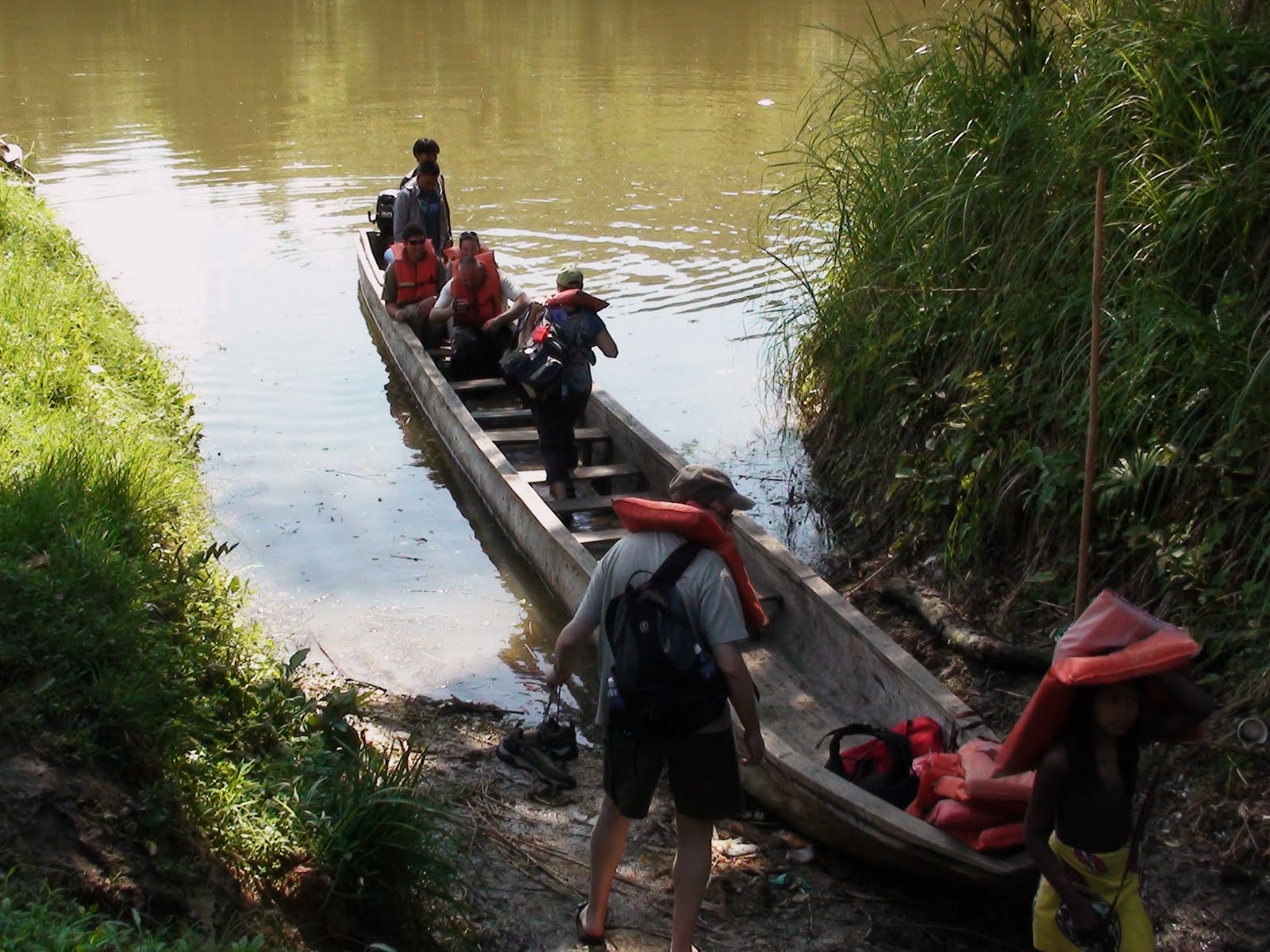 Ten of us climbed in the boat to sit two abreast, and the canoe backed out onto Lake Alajuela. Swinging around we headed down the miles-long lake at full throttle, the bow throwing up a standing wave higher than the gunwhales. The water was kept out of the canoe (mostly) only by a narrow splash rail. A steady flow of water dribbled over the edges and squirted under pressure from the small cracks near the bow, running down the 35 foot length of the canoe between our feet. It's the rainy season in Panama, and we skimmed along the coffee-with-cream colored muddy water, skirting around floating plants, sticks, and logs. In the dry season the water level is 30 feet lower, and the trip would involve navigating a small stream instead of a lake.
About 40 minutes into the ride the canoe tilted toward the right as we made a sharp turn and slowed to enter a narrow side channel. Negotiating twists and turns past low hanging branches, and ducking under those we couldn't avoid, a few minutes at idle speed brought us to a lovely waterfall that tumbled down over a ragged basalt scarp. We clambered over the sides into shin deep water and waded the remaining hundred feet or so to the pool at the base of the falls.
 It took no additional encouragement for me to plunge into the cool water and swim over for an impromptu shower under the cascade. Refreshed and soggy, we clambered back into the canoe and it backed out the way we had come. A man standing in the bow used a pole to wedge the long canoe first to the left and then the right as a means of steering.
A short run later we left the lake itself and entered the Chagres River. Another fifteen minutes of a tributary brought us to Em-bear-AH PUru, the Embera Village home of about 150 people who continue to live off the land as they always have. They welcome the occasional small group visits arranged by the American wife of one of the Embera men.
 The throaty roar of the outboard motor alerted the people of the village to our arrival long before we actually got there, and there was a group of eight men on the river bank above the landing, drumming and playing a bamboo flute to welcome us. It appeared that the entire population of the village had come down to the water's edge to meet us, the men wearing loincloths that hung to knees in front and covered much less behind. The women wore brightly colored pieces of cloth that reached from waist to just above the knees, and nothing else.
 Men, women, and children all wore purply-black elaborate tattoos with intricate geometrical designs on shoulders, backs, breasts, stomachs, buttocks, and thighs. We soon found out that the tattoos are not permanent, lasting only a week to ten days before they wear away or wash off. They are renewed frequently, both because the designs are pleasing, and because the chemicals in the plants used to draw the designs serve as a very effective bug repellent.
Click here for Part II
Tuesday, November 24, 2009
Panama City - First Impressions
We're here!
I went to bed on Tuesday at about 8:30 p.m. and actually got almost, solid four hours of sleep. I had the alarm set for 12:30, but woke a few minutes early. We were already packed. I had everything stowed in a backpack, since we were headed for the tropics, and it was only for a week. We pulled out of the driveway right on time at 1:00 a.m.
 It rained the whole 120 miles from Richmond to the Dulles Airport west of Washington, D.C. The Copa Airlines ticket counter was open when we entered the terminal, but we had to wait until 4:00 a.m. for the security inspection, so we got bagels at the only food concession open.
The sky was still pitch dark as we cleared the runway at 5:38, and the city lights disappeared immediately in the low, wet overcast. With the cabin lights out it was easy to drift off into the uneasy dozing that masquerades as sleep on an airplane. Somewhere, sometime later, breakfast was announced in Spanish, and we practiced the preying-mantis contortions necessary to cut pieces of food on a miniscule tray without knocking the bite of egg omlette off the fork of the person beside you. High rise buildings admired their own reflections in the waters of Miami Beach as we flew by.
More dozing.....half-watching the featured movie Julia and Julie, and playing with the channels to see how well the audio wizards were able to synchronize English lip movements with Spanish dubbing. Down through the hidden bumps and dips of low-hanging clouds, and onto the runway in Panama City 45 minutes early.
 The cab Lynne arranged was waiting for us, and it was about a 20 minute drive into the city. What a big city it is! There are literally hundreds of very tall, very narrow high rise buildings, with construction cranes all over the place putting up more. We are on the 33rd floor of a high-rise condo with spectacular vistas sloping up gently to the hills behind the city a few kilometers away, and the shoreline of Bahia de Panama. The bay is really nothing more than a slight curved indentation on the Pacific shoreline, and the mud-flat bottom slopes out at such a shallow angle that at low tide the water recedes a quarter to a half mile!
After getting settled we walked about three quarters of a mile to a shopping mall that makes any large mall that I've seen previously look puny by comparison! This mall was easily twice the surface area of any I've seen before, and three stories high. We found the food court and had lunch, then wandered several levels before we found the supermercado (Super Market), where we picked up bread, milk, bananas, and a half papaya. Half a papaya may seem silly until I mention that half of this fruit was a good five inches from center-slice to rind, and about 20 inches long, by far the largest I have ever seen. It will let us eat papaya with lime juice every morning for several days!
 The contrasts here are interesting. It is as if some mischief-maker took a giant stick and stirred and swirled opulent high rise buildings, abandoned factories, modest homes, small old apartment buildings, empty blocks where buildings have been or are being demolished, and tiny one-room tin-roofed houses until they were thoroughly mixed, then sprinkled all with various open-windowed schools throughout for a garnish, the drone of student recitation competing with the constant roar of traffic, horns blaring long blasts to express driver frustration at the congestion.
I need a nap! More later!
Wednesday, November 18, 2009
Richmond Marathon 26.2 miles - I DID it!
 The week before the Richmond Marathon, Joe Sullivan, Sports News Reporter for the NBC-TV Channel 12 in Richmond, called me to say that he had heard that I was the oldest person on the Marathon Training Team, and that he'd like to do an interview.
I met him down on Riverside Drive near my house, and he recorded lots of video footage of me running on the road beside the James River before doing the interview.
The piece aired on the evening news the Tuesday before the race.
An article appeared in the Richmond Times-Dispatch the same day, titled "At 71, Set For Debut"
Better late than never, indeed. George Hastings, a California native who moved to Richmond in 1984, says he has been "in and out of running most of my life He will make his marathon debut on Saturday. At age 71.
Hastings said he has been toying with the idea of running a marathon since he was a teenager. As a 16 year old, he said, he would run from his home to Oakland Technical High School, a distance of about two miles. His goal each day: to try to beat the school bus.
Years passed, and Hastings did much running but never entered a marathon. As his 71st birthday approached, he said, "I thought to myself, 'Good grief! I'm actually getting old. I've been talking about running a marathon for most of my life. It's time to either put up or shut up.'"
He has prepared for Saturday's race as a member of the Marathon Training Team.
The morning arrived. It was time. I had run a short three miles on Thursday the previous week after the TV interview, and had finished with a very sore right knee. A quick visit a few days later to the doctor revealed through an MRI that I had a torn meniscus in my right knee. The doctor, a specialist in sports medicine, said that as long as I took it VERY easy, especially going up or down hills, and wore a neoprene compression sleeve on my knee, that I could attempt the 26.2 miles, with the understanding that my knee kight just lock up, or become so painful that I would have to drop out. After five and a half months of training, I accepted those terms.
I met other runners gathering a few blocks from the starting line on Richmond's Broad Street, and as we walked the short remaining distance there was excitement and tension. The over 5,000 marathon runners were grouped according to pace per mile, with the fastest of course being in front. The winner was Jynocel Basweti, a man from Kenya, who finished the entire run in 2 hours, 18 minutes, 22 seconds!
I started out deliberately slowly, being extra cautious of my unreliable right knee. Out Broad Street a few miles, jogging a few blocks over to a few miles on Monument Avenue, a few more blocks over for another long stretch on Grove Street, and finally along Cary Street and down a steep hill to the James River. From there, across the Huguenot Bridge and along Riverside Drive. I had a big cheering section of friends and neighbors as I passed the intersection a block from my house, and Jane handed me a most welcome banana to refuel as I left the ten mile mark behind.
From there up a long climb to Forest Hill Drive, and a very long run all the way downtown to the Lee Bridge. Crossing the James River, my running muscles began to tell me, "That's it! We're finished! We're not going to do this any more!", but my brain kept pushing the unwilling mutineers for a few more miles before the muscles won the argument. There were many times I thought that I had reached the point where I would have to stop, but discovered that walking muscles are really quite different than running muscles. I found that I could keep up a brisk pace walking.
 As I came up Main Street I was joined by my friend Marilyn Elder, who ran and walked with me, holding a sign that said, "Go, George, GO!", and exhorting spectators on the sides of the street to join in the chant. It kept me laughing, and my mind off the fatigue and pain I was feeling in my hips by now. It seemed as though there had been no start and would be no end to the run by now. It was just one foot in front of the other, over and over and over. I wasn't out of breath, but the tiredness was building. I crossed Broad Street, and headed into the north side of Richmond in the last six miles, now covering distance I had never done before. My faithful self-appointed coach and publicist Marilyn joined me again as I shuffled my way toward the finish in downtown, dropping out only about a half mile from the finish line.
A block later I was joined by Chelle Quinn, the head coach of the Orange Team, and she covered the last few blocks with me. As she peeled off about two blocks from the end, I could look down the hill the remaining distance and see the huge crowd watching the stragglers coming in. I was by now the almost the only person on the street, and as I approached the finish line I was propelled onward by a wave of cheering.
 Joe Sullivan from Channel 12 was there, pointing a camera, congratulating me and asking how I felt. Of course I felt wonderful, exhausted, and in pain all at the same time, but mainly elated that I had finished!
You can see the post-marathon show that aired the next day HERE
Subscribe to:
Posts (Atom)